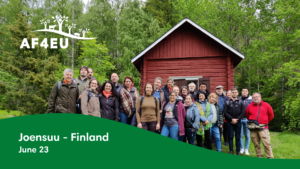

The final Finnish regional event was organised in two parts, one in Joensuu, Eastern Finland, on September 30th and the other in Tuorla, Southwest Finland, on October 2nd.
Both events included a three-hour seminar component followed by a field visit for a total of 18 participants. Participants included farm owners, advisors, researchers, and students among other involved stakeholders. The seminar facilitated fruitful discussions between segments. Participants were active in asking questions about project outputs, sharing diverse personal experiences and opinions, and reacting to the contributions of others.
The seminar sessions included presentation of project results and outputs, provision of selected materials as prints, and demonstrations of the AF4EU digital resources, the Knowledge Cloud, AFI-BUS Decision Support System, Open Online Courses, and the Alive Handbook. Three project videos on local examples of farms practicing specific agroforestry practices were also shown, sparking conversation about opportunities and challenges for agroforestry in Finland. Participants were especially eager to discuss the barriers to investment and public funding, and lack thereof, for supporting establishment of independent businesses.
In Eastern Finland, the field visit was to Sammallahti Farm, which practices forest grazing in a traditional rural biotope. After an on-site lunch, the farmer, Antti Mutanen, gave an informative tour of the forested site and biodiverse terrain. Accompanied by a herd of curious grazing sheep, this provided unique insight into not only the practical aspects of forest grazing, but its historical origins, and the benefits and challenges linked to its establishment and continuation. Participants heard about the strict conditions of subsidised funding received by traditional rural biotopes in Finland, and how these shape the operation of the farm.
In Southern Finland, the seminar and field visit both took place at Livia College. The vocational school has an innovative alley cropping pilot with hazelnuts, and participants got to see the site as presented by Livia’s horticultural teacher and manager of the site, Liina Leivonmaa. This was followed by an extended tour to the rest of the school’s active lush farmland, including two forest grazing locations and a forest garden growing an abundant range of different fruits, nuts, and berries.
The two events attracted a diverse set of participants, extending project knowledge exchange outside the Finnish RAIN. In southern Finland, students studying horticulture made up a portion of participants. The curiosity and enthusiasm of the younger generation of innovators was evident among them and contributed to the diversity of discussions among the participants.