
The 4th and final AF4EU workshop of the German RAIN took place in the Innovation Workshop Centre at Anhalt University of Applied Sciences in Bernburg, Saale.
The event took place on 24th February 2025, gathering 84 participants from 12 of the 16 German federal states, bringing together farmers, researchers, advisors, policymakers, and other key stakeholders to discuss the progress of the AF4EU project and explore opportunities and challenges in agroforestry innovation across Germany.
The day began with a welcoming session, followed by a series of interactive presentations and discussions focused on practical, technical, and strategic aspects of agroforestry development. The event offered a platform for cross-regional exchange, showcasing the growing interest and expansion of the agroforestry network nationwide.
One of the central sessions highlighted the role of Operational Groups (OGs) and the opportunities offered by the EIP-AGRI framework. Four exemplary OGs from across Europe were presented, illustrating how agroforestry can address both environmental and economic challenges. The session also addressed key obstacles such as administrative complexity, limited research integration, and legal uncertainties. Participants offered suggestions including simplifying procedures, strengthening expert panels, and improving funding structures.
The workshop also spotlighted the AF4EU Knowledge Platform, which includes tools such as the Knowledge Cloud (KC) and the Massive Open Online Course (MOOC). These resources aim to equip advisors and stakeholders with both technical and soft skills, reinforcing the importance of continuous learning in agroforestry practice. The CECRA training program and the distinctions between facilitation and instruction were also explored.
A dedicated coffee networking session allowed participants to engage with three posters summarizing farm characteristics, inputs, and livestock/water management. In small rotating groups, attendees provided valuable feedback and recommendations for improvement. Suggestions included developing demonstration objects, separating water management as a standalone topic, and exploring synergies with AgriPV, CO₂ certification, and agroforestry’s perennial nature and cost structure.
Another key activity was the interactive session on the Agroforestry Innovation Business Decision Support System (AFi-Bus DSS). Using a Business Model Canvas approach, three teams analyzed nine building blocks of the tool, identifying strengths, weaknesses, opportunities, and threats. Discussions emphasized the system’s potential to promote environmental responsibility and personal engagement, while also underlining the need for stronger policy support and improved partnerships.
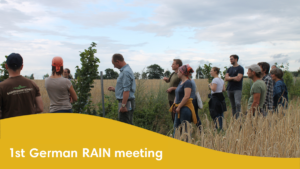
The workshop concluded with two field trips. One focused on traditional woody plantings and windbreak hedges, discussing their renewal and potential for added value. The other took place at Anhalt University of Applied Sciences, where participants explored biochar experimental plots. These visits encouraged lively exchanges on the role of agroforestry in providing organic materials for biochar production and the potential of combining both practices to boost soil health and carbon sequestration.
In conclusion, the 4th German RAIN workshop successfully brought together a diverse group of stakeholders to exchange ideas, evaluate tools, and promote the future of agroforestry in Germany. The event highlighted the importance of continued institutional support and innovation to scale up sustainable agroforestry practices across the country.