
Belgian RAIN Workshop Highlights Innovative Agroforestry Approaches and Systemic Challenges
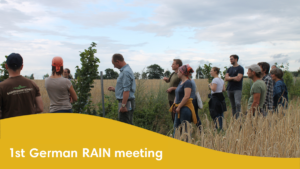
The 4th workshop of the Belgian Regional Agroforestry Innovation Network (RAIN) took place on February 25, 2025, in Merelbeke-Melle, East Flanders. The event brought together 14 stakeholders from across the agroforestry spectrum, including farmers, researchers, advisors, policymakers, and small and medium-sized enterprises (SMEs), to assess the progress of the AF4EU project and explore innovation opportunities in agroforestry development.
The workshop began with an introductory session that laid a strong foundation for the day’s discussions, followed by a second session focused on the Knowledge Cloud (KC) and the Massive Open Online Course (MOOC), highlighting the significance of soft skills in agroforestry advisory services. Among the positive aspects of the project’s advisory approach, stakeholders highly valued tailored advisory services, collaborative networks, and enhanced capacity. However, gaps in technical knowledge and limitations in advisory accreditation were identified as areas needing further development.
The third session turned to the implementation of Operational Groups (OGs) within the EIP-AGRI framework. Two Flemish agroforestry OGs were presented: FoodForward, which develops innovative food forest models that integrate ecosystem services, and P’Orchard, which combines outdoor pig farming with silvopasture systems to enhance both economic and environmental value chains. While these examples showcased local innovation, participants also voiced concerns. The current open-call funding model in Flanders, paired with relatively low funding compared to other EU regions, poses barriers for agroforestry-specific OGs. Additionally, managing an OG remains an administratively demanding task, and awareness of OG opportunities remains limited among practitioners.
An interactive coffee networking session followed, allowing participants to rotate through thematic poster discussions on key agroforestry data topics. The five posters covered farm household characteristics, land use, input costs, livestock management, and water/financial resources. While there was broad agreement with the content, useful feedback was also provided. For instance, stakeholders pointed out the lack of inclusion of various labor types (seasonal, part-time, student workers) and emphasized the need for integrating tools with existing data systems to reduce the time burden on farmers. For input quantification, a suggestion was made to create a “lite” version of the tool to encourage broader adoption. Enhancing links between digital tools and policy frameworks was also a recurrent theme.
The final session focused on the Decision Support System (DSS), AFi-Bus. The participatory exercise provided valuable feedback for refining the tool from a Belgian perspective. Most stakeholders agreed on the importance of considering internal and external factors in agroforestry planning. Challenges discussed included financial constraints, policy and regulatory hurdles, and limited technical capacity. Nevertheless, participants identified several enabling factors, such as improved financial performance, enhanced sustainability, stronger partnerships, and new market opportunities.
Participants also highlighted a common risk with digital tools, ending up in a “tool graveyard” if not adequately adopted. To ensure AFi-Bus avoids this fate, its unique value must be clear, and it should be effectively integrated with ongoing agroforestry initiatives. Strengthening its connection with networks, projects, and advisory systems will be key to long-term sustainability and practical impact.
In conclusion, the fourth Belgian RAIN workshop successfully fostered dialogue among diverse stakeholders, shedding light on both the innovative efforts already underway and the systemic barriers that need to be addressed. Continued collaboration and strategic investment will be critical to scaling agroforestry practices across Flanders and beyond.